Draft 2026 NBA Draft Prospects Thread

Do we trade away our pick or draft a player?

  • Draft

    Votes: 50 84.7%
  • Trade

    Votes: 5 8.5%
  • Cash Considerations

    Votes: 4 6.8%

  • Total voters
    59
Realistically speaking, what are peoples' assessments of Castle and Harper's ability to shoot in the future? For reference, Jrue Holiday in his 20s topped out as a 35% shooter on 5.7 attempts per game in his age 29 season. Jalen Suggs had 1 season shooting close to 40% and has been around 31% every other year. Fox has had 1 season shooting 37% on 8 attempts in his age 26 season, outside of that before this season he's been low 30s. Looking at these comparisons, is it likely to expect both Harper and Castle to achieve 35% shooting on 6-7 attempts in the next 4 years when they'll be 24 and 25 respectively?

And if you take these two and Fox to be your backcourt for the next 4 years, where two are going to be on the court at any given time, does it make sense to overindex on shooting at the 3 and 4 and give up some size and rebounding? This is why Champagnie's development this year has been critical and he needs to be retained if at all possible. This is also why Carter Bryant's development is critical - he had all the shooting signals coming in - shot 36% on 8 3PA/100, FT were low in college but was shooting high 70's on a much larger sample size in high school indicating that he has a shot at becoming a good high volume shooter.

This is why I worry some about taking guys who seemed like they made sense previously - Yaxel, Karim Lopez, Cenac, Ament, Haugh, Tounde, even though I like a lot of these guys. These are not guys who profile as high volume shooters who can compensate for lack of guard gravity. On a normal team with at least 1 +shooter in the backcourt any of these guys would work fine, but this works less well Castle/Harper/Fox backcourt, specifically in the next 3-4 years. Guys like PJ Washington/Okongwu, while decent shooters for position, are probably not going to cut it at the 4. Then when Wemby goes to the bench, if you have Kornet out there who doesn't shoot 3s, that's 3 negative spacers relative to position. If you look at the best shooting wings in the draft, most guys like Karaban, Momcilovic, Pryce Sandfort basically don't offer any ancillary skills aside from high volume shooting and so might only be good in a bit context.

Then you look at shooting wings who offer other skills - high volume 3PA, decent FTR/rim attempts indicating the ability to get to the rim when they're closed out, BLK/STL%, rebounding, passing ability, and you get:

Keaton Wagler
Cam Carr
Braylon Mullins
Isaiah Evans
Paul McNeil

Mullins and McNeil are slight shooting guards who can't get to the rim
Wagler would be awesome, but he's trending to a top 6-8 pick and is going to be out of the Spurs range
I'm not sure how Evans has been this year, but last year he literally didn't offer anything except shooting

This is why I'm starting to trend back to Cam Carr. The combine measurements are going to be huge for him - ESPN lists him at 175 lbs, Baylor lists him at 190. 175 puts him in Rob Dillingham weight and that's a non-starter for me. 190 with the potential to increase to 200 is wing territory and palatable to me, especially if he measures out 6'6 in shoes with a 7'1 wingspan as has been widely rumored. He offers secondary rim protection and some rebounding due his high level vertical pop, he shoots 40+ percent on contested and uncontested catch and shoots, his confidence is sky high, he takes and hits some very deep 3s, and he gets to the line often. I'm not looking for him to play the 4, but rather the 3 with Champ/Bryant manning the 4 while we have a minus shooting backcourt. I really hate overindexing on shooting, but I feel like if you truly believe in Castle/Harper as the backcourt of the future this is probably the way the team has to go.

For defending big forwards of the future (Randle/Gordon/Boozer/Scottie Barnes etc), see if you can grab Morez Johnson in the early second round to do his best Okongwu/Beef Stew cosplay for the future and replace Harrison Ingram. Yaxel would really be ideal here but there's no way he lasts until the second round unless you can trade the Hawks pick for 2 mid-firsts. Morez is putting up similar numbers at age 20 as Okongwu at 19, his FT% is up to 80% this year and he's shooting 40% from 3 on very low volume with good percentages from midrange so the shot is something that might come around in the future.

Finally, go get Krivas with a third second rounder to be your third big, he's 7'2", he anchors Arizona's defense, and he's shooting like 80% from FT so he should be serviceable. I'd normally say something like Ivisic for his shooting but I stopped taking him seriously as a prospect last year when CMB looked like Shaq vs Shawn Bradley against him last year.
 
Realistically speaking, what are peoples' assessments of Castle and Harper's ability to shoot in the future? For reference, Jrue Holiday in his 20s topped out as a 35% shooter on 5.7 attempts per game in his age 29 season. Jalen Suggs had 1 season shooting close to 40% and has been around 31% every other year. Fox has had 1 season shooting 37% on 8 attempts in his age 26 season, outside of that before this season he's been low 30s. Looking at these comparisons, is it likely to expect both Harper and Castle to achieve 35% shooting on 6-7 attempts in the next 4 years when they'll be 24 and 25 respectively?

And if you take these two and Fox to be your backcourt for the next 4 years, where two are going to be on the court at any given time, does it make sense to overindex on shooting at the 3 and 4 and give up some size and rebounding? This is why Champagnie's development this year has been critical and he needs to be retained if at all possible. This is also why Carter Bryant's development is critical - he had all the shooting signals coming in - shot 36% on 8 3PA/100, FT were low in college but was shooting high 70's on a much larger sample size in high school indicating that he has a shot at becoming a good high volume shooter.

This is why I worry some about taking guys who seemed like they made sense previously - Yaxel, Karim Lopez, Cenac, Ament, Haugh, Tounde, even though I like a lot of these guys. These are not guys who profile as high volume shooters who can compensate for lack of guard gravity. On a normal team with at least 1 +shooter in the backcourt any of these guys would work fine, but this works less well Castle/Harper/Fox backcourt, specifically in the next 3-4 years. Guys like PJ Washington/Okongwu, while decent shooters for position, are probably not going to cut it at the 4. Then when Wemby goes to the bench, if you have Kornet out there who doesn't shoot 3s, that's 3 negative spacers relative to position. If you look at the best shooting wings in the draft, most guys like Karaban, Momcilovic, Pryce Sandfort basically don't offer any ancillary skills aside from high volume shooting and so might only be good in a bit context.

Then you look at shooting wings who offer other skills - high volume 3PA, decent FTR/rim attempts indicating the ability to get to the rim when they're closed out, BLK/STL%, rebounding, passing ability, and you get:

Keaton Wagler
Cam Carr
Braylon Mullins
Isaiah Evans
Paul McNeil

Mullins and McNeil are slight shooting guards who can't get to the rim
Wagler would be awesome, but he's trending to a top 6-8 pick and is going to be out of the Spurs range
I'm not sure how Evans has been this year, but last year he literally didn't offer anything except shooting

This is why I'm starting to trend back to Cam Carr. The combine measurements are going to be huge for him - ESPN lists him at 175 lbs, Baylor lists him at 190. 175 puts him in Rob Dillingham weight and that's a non-starter for me. 190 with the potential to increase to 200 is wing territory and palatable to me, especially if he measures out 6'6 in shoes with a 7'1 wingspan as has been widely rumored. He offers secondary rim protection and some rebounding due his high level vertical pop, he shoots 40+ percent on contested and uncontested catch and shoots, his confidence is sky high, he takes and hits some very deep 3s, and he gets to the line often. I'm not looking for him to play the 4, but rather the 3 with Champ/Bryant manning the 4 while we have a minus shooting backcourt. I really hate overindexing on shooting, but I feel like if you truly believe in Castle/Harper as the backcourt of the future this is probably the way the team has to go.

For defending big forwards of the future (Randle/Gordon/Boozer/Scottie Barnes etc), see if you can grab Morez Johnson in the early second round to do his best Okongwu/Beef Stew cosplay for the future and replace Harrison Ingram. Yaxel would really be ideal here but there's no way he lasts until the second round unless you can trade the Hawks pick for 2 mid-firsts. Morez is putting up similar numbers at age 20 as Okongwu at 19, his FT% is up to 80% this year and he's shooting 40% from 3 on very low volume with good percentages from midrange so the shot is something that might come around in the future.

Finally, go get Krivas with a third second rounder to be your third big, he's 7'2", he anchors Arizona's defense, and he's shooting like 80% from FT so he should be serviceable. I'd normally say something like Ivisic for his shooting but I stopped taking him seriously as a prospect last year when CMB looked like Shaq vs Shawn Bradley against him last year.
Between Harper and Castle I see Harper being the better shooter long term, but not a great one. I really don't see how they can play together unless your 3 and 4 are knockdown 3D guys and one of them can rebound. It seems like we need to choose one of them sooner rather than later because they both have skills that will command max money, but don't fit together.
 
@SpursBills

I agree with you that there isn't an obvious fit projected between #10 and #20 for Spurs at that early stage of the draft. It might be different in 3 months but that's the current situation.

Some additional points:

- It's looking more and more like Spurs might be headed into trading Fox this summer.
First, Harper and Castle confirms being great prospects who will be soon high quality starters.
Second, despite their efforts, Fox/Castle/Harper are struggling to fit together.
If Fox is traded, drafting a guard who is a great shooter becomes a good option.

- Spurs might just trade the pick for either future pick(s) or a player. It is what they did when they didn't like available players at #8 in 2024.

- If Spurs draft a raw and young high ceiling player, there are no immediate fit issues because it will take a couple of years for that player to be ready. Castle/Harper might have improved their shot by that time, Kornet and Vassell might be gone... A player who isn't a good fit with Spurs in 2026/2027 might turn into a good one in 2028/2029.
 
Can I interest anyone in a 6'6" guard from UCONN? Braylon Mullins is going to be a star in the NBA.

 
He’ll be a high level 3&D, but nothing more. He doesn’t rebound, assist, or get to the line.
Which is useful here, but less so than a PF or SF who can shoot and rebound. That puts him on the board, but not at the top.
 
Which is useful here, but less so than a PF or SF who can shoot and rebound. That puts him on the board, but not at the top.
Oh, he would be useful. I was just contesting the notion that he’d be a star.
 
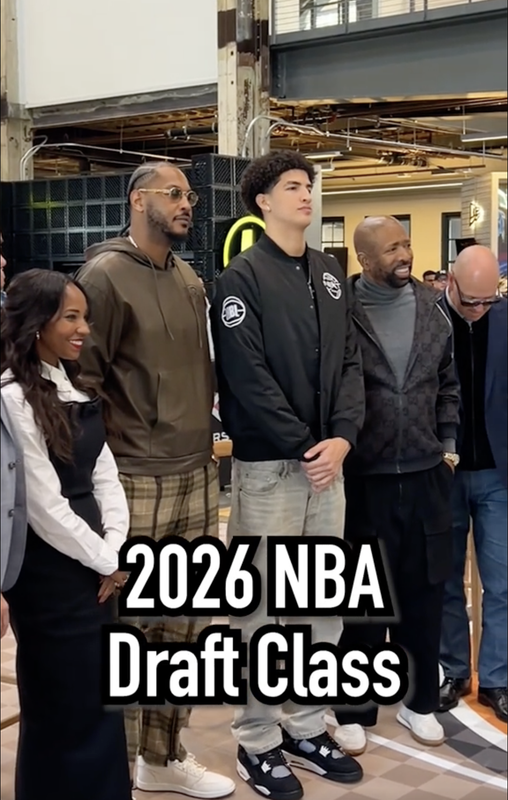
Karim Lopez standing beside 6'8 (in shoes) listed Carmelo Anthony. Kid has definitely grown in the past few months.

IMG_3698.jpg


Screenshot-2026-02-03-at-10-29-51-AM.png
 
Lopez will go top 10. And some team will think twice if they pick Wilson instead of Lopez.
 
id been on team AJD for a while now, but Vecenie made a good observation that tracks with what ive seen. he never seems to blow by guys. he's very athletic/physical, can initiate and score through contact, use his strength to get some separation for a pull-up, etc, but he's never just outright getting by his guy for a layup
 
Vecenie's article on tanking, a really good read.

After NBA trade deadline, tanking season is about to bring new levels of losing​

The perfect tanking storm has come to the NBA’s shores, and it’s arriving in the face of league scrutiny regarding both gambling and its own competition balance concerns.

That was my immediate takeaway from the chaos of this year’s trade deadline. Over the next two months, a race to the bottom will ensue, the likes of which the NBA has not seen before, thanks to a confluence of events that has become starker this week.

First and foremost, the 2026 NBA Draft has multiple elite prospects at the top. BYU wing AJ Dybantsa, Kansas guard Darryn Peterson and Duke forward Cameron Boozer are projected to end up as Tier One prospects for me, or players I think have a significant chance at All-NBA upside. I don’t have any of those three right now with a higher grade than I gave to Cooper Flagg last year, but in the decade-plus that I’ve been scouting the NBA Draft, I’ve never had three players as Tier One prospects in a single class. Illinois guard Keaton Wagler, Houston guard Kingston Flemings, and North Carolina forward Caleb Wilson project as at least Tier Two players, a rating I give to prospects I believe have a significant likelihood of All-Star upside. I’ve never had at least six Tier One and Tier Two players in a draft class.

Secondly, the two draft classes after that are not viewed as particularly strong. In the 2027 class, I would not project any prospect to be rated ahead of the top six 2026 players. Prospects like Jordan Smith Jr., Bruce Branch III and Tyran Stokes are terrific, but they’re not on quite the same level as Dybantsa, Peterson, Boozer or Flagg. I’m not alone in that opinion. When I speak with scouts around the NBA, they are concerned about the top-end talent of the 2026 recruiting class as a whole. While it’s too early to project the 2028 NBA Draft, we have not yet seen a player emerge who looks to be on a Tier One level, either. And by now, we typically have a good sense of those truly elite talents.

Teams seem to have made decisions at the trade deadline with tanking in mind, despite the league so desperately wanting to expunge that tactic. I count no fewer than 10 teams that have very little incentive to win games the rest of the season. Let’s look at how dire the final two months of the season could get:

● The Sacramento Kings are 12-40 and completely out of the Play-In Tournament picture in the Western Conference, 11 1/2 games behind the Portland Trail Blazers. The Kings’ lone trade this deadline was consummated, in part, to give rookie Nique Clifford some on-ball reps. They desperately require the kind of elite talent and upside that a top pick in this 2026 draft would provide.

● The New Orleans Pelicans (13-40) have no incentive to tank, as they traded away their first-round pick in an ill-conceived swap at the draft last year to select Derik Queen. However, the Pelicans want to play Queen and rookie guard Jeremiah Fears, and the team’s lineups tend to tank when either of those two is on the court.

● The Indiana Pacers (13-38) strongly incentivized themselves to tank the rest of the way by acquiring Ivica Zubac from the LA Clippers on Thursday and including a creatively protected draft pick. The Pacers will keep their 2026 first-round pick if it lands in the top four, will trade it to the Clippers if it ends up in the No. 5 to No. 9 range and will keep it if it ends up outside of the top 10. With Indiana already 10 games back of the Play-In, it’s incentivized to maximize its chances to keep this pick. The Pacers will, at best, have a 52 percent chance to keep it by staying in the bottom three of the standings. Having a 50/50 shot to keep their pick versus a 37 percent chance to it if they drop down to sixth-worst in the standings should tell you where their priorities will lie.

● The Brooklyn Nets (13-37) are arguably in the most dire situation roster-wise in the league and desperately need a player that they can start building around as a true No. 1 option. Lottery pick Egor Demin has been good and looks like a building block, but he does not look like a future top option.

● The Washington Wizards (14-36) acquired Trae Young and Anthony Davis before the deadline but are still 8 1/2 games out of the Play-In and have very little incentive to win games. Young has not yet played for the Wizards despite being acquired a month ago, and I would bet they employ a similar strategy with Davis, who is out with a left hand injury. The Wizards owe their draft pick to the New York Knicks if it falls out of the top eight.

● The Utah Jazz (16-36) also made a buy-now move to get Jaren Jackson Jr., but they are in a similar position to the Pacers. The Jazz’s pick will go to the Oklahoma City Thunder if it falls outside of the top eight, but future obligations to the Thunder go away if Utah keeps the selection. Some NBA executives have already jokingly wondered what kind of mysterious malady Jackson will come down with during the All-Star break.

● The Dallas Mavericks (19-32) are officially rebuilding around Cooper Flagg following the Davis trade. They don’t have access to their own draft pick from 2027 to 2030. This is potentially the last time they might have a high draft pick during Flagg’s rookie contract.

● The Memphis Grizzlies (20-29) just traded Jackson and are clearly also rebuilding now around Zach Edey and Cedric Coward. They need to find a No. 1 option in the draft and are equally incentivized to lose.

● The Milwaukee Bucks (20-29) did not trade Giannis Antetokounmpo and are just two games back of the Play-In. But Antetokounmpo is out for the foreseeable future with a right calf injury, and the team is 5-14 in games he has not played this season. The Bucks might find themselves out of the Play-In picture by the time he gets back. They should also want the highest draft pick possible to either build around him, move forward without him this offseason or offer it in a trade for a star to persuade him to sign the four-year, $275 million extension they can table him in October.

● Finally, while the Portland Trail Blazers and Charlotte Hornets are trying to win, the Chicago Bulls (24-28) just did a fire sale even though they’re currently in the Play-In. The team has two healthy bigs (Guerschon Yabusele and Jalen Smith), neither of whom is taller than 6-foot-8. They desperately need to find a centerpiece to build around Matas Buzelis and Josh Giddey.

We will see games in March and April featuring players who even the most ardent NBA fans did not know were in the league. We’re going to get games in which the Kings experiment with Maxime Raynaud as the featured option, and games in which the Nets empower Demin to really explore the studio space as a lead guard — even though he has made as many 3-pointers as he has attempted 2-pointers this season (107). I’m not sure we’ve ever seen this many teams in February that might push the tanking boundaries.

The real question is how the league will respond over the next two months. At December’s Board of Governors meeting, the NBA sounded out teams on ideas about how to modify the rules regarding tanking. Will the league aggressively investigate and pursue sanctions with fines for teams that sit players out? One NBA executive asked this question: Will teams even care if they get fined?

“The value of confirming a top-five pick or improving your chances at a top-two pick in this draft class is very large,” said the executive, who was offered anonymity in exchange for his candor. “Is it worth $5 million if you keep getting fined by the PPP (player participation policy) and the price tag rises? Is it worth $10 million if you’re successful? We haven’t done modeling on that, but it wouldn’t surprise me if a team has and comes to the conclusion that getting access to one of the top players in this draft is worth a certain amount in fines.”

The NBA’s player participation policy gets extreme in a hurry. If a team rests a player who is subject to the policy without an approved reason, the league can issue a $100,000 fine for the first violation, a $250,000 fine for a second violation and up to $1 million for each successive offense. Teams can model value in dollar figures all they want, but it would take an owner who was extremely bought into the process to burn cash like this.

In that Board of Governors meeting, the NBA also presented ideas to combat tanking that will be stress-tested throughout this final two-month period. One of them was limiting pick protections to either the top four or Nos. 14 and higher. That would have prevented the Pacers and Clippers from meeting in the middle of the lottery in their creative deal. Another possible solution was to lock the lottery order after March 1, so that teams would tank until then.

I’ve spoken to about a dozen NBA executives about tanking reform in the last month and a half, and opinions are split on the idea.

Some executives — even ones representing teams currently slotted within the lottery — are strongly in favor of the league’s actions. The idea of competitive balance for teams vying for playoff spots and how schedule imbalances can affect those races are obviously brought up. Several executives have also noted that games in March and April are sometimes difficult to evaluate properly because of the level of talent and the experimentation that coaches are employing. No one ever accuses players of not playing hard, but the games just tend not to resemble early and midseason NBA action. Among league sources I’ve spoken with, locking the lottery on a certain date — be it March 1, March 15 or even at the trade deadline itself — tends to be the most popular solution.

And yet, other executives think things should stay as they are. It’s not that they don’t see the problem; it’s rather that they worry about unforeseen side effects of potential solutions. They worry, for example, that more teams will simply tank to start the season and choose not to field competitive teams from the outset. These executives also appreciate the flexibility and creativity required to come up with deals involving draft capital.

More than anything, some executives don’t believe there is a real solution. They say that acquiring elite players in the draft and having them locked under often under-market contracts for nearly a decade is simply too valuable. Because basketball is such an individually driven sport, players like recent No. 1 picks Cade Cunningham, Anthony Edwards and Victor Wembanyama bring too much value to an organization, and teams will always work within whatever constraints the rules present to land such players.

Lottery reform has, in some ways, worked as intended. But in other ways, it has created more problems. Because it’s so hard to win the lottery now, teams like the Jazz, Wizards and Nets have embarked upon long, multi-year tanks because they have gotten so unlucky with the ping-pong balls. Meanwhile, teams like the Houston Rockets and San Antonio Spurs continually get lucky and move up. Multiple years of non-competitive play wear down fan bases while not actually changing the behavior of teams all that much.

Regardless, we’re about to see one of the all-time races to the bottom. Whether the league seeks safety from the storm will be a significant question for commissioner Adam Silver to answer.
 
In his last 10 games, Lendeborg is 7/42 from behind the arc...

The rise of Carter Bryant changes a lot of things regarding the draft. Spurs might enter this summer without a significant hole. In that case, trading the pick for future pick(s) like they did with #8 in 2024 makes a lot of sense. Small weaknesses in Spurs roster (third string center, a shooter...) can be fixed with the MLE and second round picks.
 
In his last 10 games, Lendeborg is 7/42 from behind the arc...

The rise of Carter Bryant changes a lot of things regarding the draft. Spurs might enter this summer without a significant hole. In that case, trading the pick for future pick(s) like they did with #8 in 2024 makes a lot of sense. Small weaknesses in Spurs roster (third string center, a shooter...) can be fixed with the MLE and second round picks.
Or we'll just have the luxury of taking another wing project that doesn't need to contribute right away.
Or even a big man project that would take over from Kornet in a couple of years.

It will surely come down to if the Spurs value whoever is available enough to make the pick.
 

Tounde all the way until the draft, baby

People haven’t learned to listen yet when I make these calls. Too bad
 
Or we'll just have the luxury of taking another wing project that doesn't need to contribute right away.
Or even a big man project that would take over from Kornet in a couple of years.

It will surely come down to if the Spurs value whoever is available enough to make the pick.
Yep, not having an obvious need just opens a lot of possibilities for that pick.
 
Yep, not having an obvious need just opens a lot of possibilities for that pick.
I'm more interested in the second round, right now we're at #36, #43, #45.
If we don't get a third string big, I'll be upset.
 
Now that conference play has started, just wanted to look back at some of Spurs draft picks in recent years. I've touched on this in the past, but looking at these draft picks grouped together, it's clear that Brian Wright definitely has a "type":


YearNameDraft AgeTeamTeam Rank (Kenpom)MPGP/R/A
2020Devin Vassell19.8Florida State152913/5/1.5
2021Josh Primo18.5Alabama9238/3.5/1
2022Jeremy Sochan19.1Baylor4259/6.5/4.5
2024Stephon Castle19.6UConn12711/5/3
2025Carter Bryant19.6Arizona13196.5/3/1

I excluded Wemby and Harper because they were consensus picks at the time. But for non-consensus picks, what we see is a trend of toolsy young college Freshmen who played a role on top 20 teams. Generally these prospects were also lauded by their coaches for their work ethic or character (lol Primo). That may change this year as the Spurs are transitioning into becoming a contending team with a core that is set, but it's undeniable that this has been Brian Wright's preference for the last 5 years.

Looking at this year's potential prospects, we can apply a similar criteria - toolsy freshmen / very young sophomores contributing to a top 20 college team:

Koa Peat (Arizona)
Keaton Wagler (Illinois)
Chris Cenac (Houston)
Braylon Mullins (UConn)
Cameron Boozer (Duke)
Patrick Ngongba (Duke)
Darren Peterson (Kansas)
Nate Ament (Tennessee)
AJ Dybantsa (BYU)

I eliminated a lot of other freshmen who I don't consider great 2026 draft prospects because they're not really ready (Dame Sarr, Ivan Kharchenkov, David Mirkovic). Boozer, Peterson, Dybantsa we can eliminate right away because they're going top 4. Wagler's going top 8 and I think Ament is probably trending that way with his recent play. This leaves:

Koa Peat (Arizona)
Chris Cenac (Houston)
Braylon Mullins (UConn)
Patrick Ngongba (Duke)

Of these, the one who fits like a glove with the Spurs prior draft picks is Cenac. In fact, if I put him in the above table, he would not look out of place at all:


YearNameDraft AgeTeamTeam Rank (Kenpom)MPGP/R/A
2020Devin Vassell19.8Florida State152913/5/1.5
2021Josh Primo18.5Alabama9238/3.5/1
2022Jeremy Sochan19.1Baylor4259/6.5/4.5
2024Stephon Castle19.6UConn12711/5/3
2025Carter Bryant19.6Arizona13196.5/3/1
2026Chris Cenac19.4Houston72510/8/1

This finding really pissed me off early on because I hated Cenac as a prospect during the early parts season and I think he still has some issues, but I've come around on him big time as a prospect over the last month as he's really found his footing in Kelvin Sampson's system.

First of all, Cenac (who has barely been mentioned on this board, probably because he sucked ass early this season) is a non-rim protecting jump shooting big. Anthros: 6'11, 7'3 wingspan, 9'1 standing reach, 235. He's a decent athlete, fairly switchable on the perimeter for a big, but in no way can ever be seen as a big wing, he is a big through and through, and one who doesn't protect the rim particularly well (3 BLK%). His future outlook exists on some spectrum between Tyler Smith, Bobby Portis, and LaMarcus Aldridge/Chris Bosh.

I really disliked him early this season for his high rate of fouling, terrible AST:TO suggesting low feel, bad FT% suggesting his shot is fake, and I didn't think that there was any room for a soft non-rim protecting big.

Digging into the numbers a little bit, however, leave me with a much better feeling about his future projection.

Cenac.webp
Since conference play began, he's cut his turnovers and fouling down big time while maintaining his excellent rebound rates. While his FT are low, he has a much larger sample of 3s and long 2's, which he's hitting at way above average rates for someone who's a poor jump shooter. I think the jumper is real, as he has excellent form and seems unbothered by closeouts by shorter players. He's also been lauded by Kelvin Sampson for his work ethic and coachability:


Is there room for this type of player in the Spurs current roster construction? I think so. While my preference is to run 2 wings next to a Harper/Castle backcourt, and Carter Bryant's future emergence makes this possible, I think that having a shooting true big who can toggle between starting PF (allowing CB to play the 3), backup PF, and has the size to play backup C will always be valuable, especially as the league moves away from smallball and employs more true bigs. At his best, Cenac can be like a JJJ-lite on offense who can space the floor and set screens. On defense, he's a much better rebounder than guys Portis or JJJ in college and he's excellent at getting out-of-area rebounds using his length and athleticism. He's also decently mobile and switches well, although even at his peak he may be more of an LMA style defender where he's good at swiping down at guys and getting steals rather than being a true rime protector.

Again, there are other prospects out there who may be better fits, or are playing better. Lopez, Yaxel, Hannes, Tounde, are all guys that have gotten a fair amount of love on this board and while I actually wouldn't be unhappy with any of those guys, Cenac looks more and more like a "Brian Wright" prospect who may hear his name called by the Spurs come June. He'll be one to monitor moving forward.
 
Last edited:
Now that conference play has started, just wanted to look back at some of Spurs draft picks in recent years. I've touched on this in the past, but looking at these draft picks grouped together, it's clear that Brian Wright definitely has a "type":


YearNameDraft AgeTeamTeam Rank (Kenpom)MPGP/R/A
2020Devin Vassell19.8Florida State152913/5/1.5
2021Josh Primo18.5Alabama9238/3.5/1
2022Jeremy Sochan19.1Baylor4259/6.5/4.5
2023Stephon Castle19.6UConn12711/5/3
2024Carter Bryant19.6Arizona13196.5/3/1

I excluded Wemby and Harper because they were consensus picks at the time. But for non-consensus picks, what we see is a trend of toolsy young college Freshmen who played a role on top 20 teams. Generally these prospects were also lauded by their coaches for their work ethic or character (lol Primo). That may change this year as the Spurs are transitioning into becoming a contending team with a core that is set, but it's undeniable that this has been Brian Wright's preference for the last 5 years.

Looking at this year's potential prospects, we can apply a similar criteria - toolsy freshmen / very young sophomores contributing to a top 20 college team:

Koa Peat (Arizona)
Keaton Wagler (Illinois)
Chris Cenac (Houston)
Braylon Mullins (UConn)
Cameron Boozer (Duke)
Patrick Ngongba (Duke)
Darren Peterson (Kansas)
Nate Ament (Tennessee)
AJ Dybantsa (BYU)

I eliminated a lot of other freshmen who I don't consider great 2026 draft prospects because they're not really ready (Dame Sarr, Ivan Kharchenkov, David Mirkovic). Boozer, Peterson, Dybantsa we can eliminate right away because they're going top 4. Wagler's going top 8 and I think Ament is probably trending that way with his recent play. This leaves:

Koa Peat (Arizona)
Chris Cenac (Houston)
Braylon Mullins (UConn)
Patrick Ngongba (Duke)

Of these, the one who fits like a glove with the Spurs prior draft picks is Cenac. In fact, if I put him in the above table, he would not look out of place at all:


YearNameDraft AgeTeamTeam Rank (Kenpom)MPGP/R/A
2020Devin Vassell19.8Florida State152913/5/1.5
2021Josh Primo18.5Alabama9238/3.5/1
2022Jeremy Sochan19.1Baylor4259/6.5/4.5
2023Stephon Castle19.6UConn12711/5/3
2024Carter Bryant19.6Arizona13196.5/3/1
2025Chris Cenac19.4Houston72510/8/1

This finding really pissed me off early on because I hated Cenac as a prospect during the early parts season and I think he still has some issues, but I've come around on him big time as a prospect over the last month as he's really found his footing in Kelvin Sampson's system.

First of all, Cenac (who has barely been mentioned on this board, probably because he sucked ass early this season) is a non-rim protecting jump shooting big. Anthros: 6'11, 7'3 wingspan, 9'1 standing reach, 235. He's a decent athlete, fairly switchable on the perimeter for a big, but in no way can ever be seen as a big wing, he is a big through and through, and one who doesn't protect the rim particularly well (3 BLK%). His future outlook exists on some spectrum between Tyler Smith, Bobby Portis, and LaMarcus Aldridge/Chris Bosh.

I really disliked him early this season for his high rate of fouling, terrible AST:TO suggesting low feel, bad FT% suggesting his shot is fake, and I didn't think that there was any room for a soft non-rim protecting big.

Digging into the numbers a little bit, however, leave me with a much better feeling about his future projection.

View attachment 803
Since conference play began, he's cut his turnovers and fouling down big time while maintaining his excellent rebound rates. While his FT are low, he has a much larger sample of 3s and long 2's, which he's hitting at way above average rates for someone who's a poor jump shooter. I think the jumper is real, as he has excellent form and seems unbothered by closeouts by shorter players. He's also been lauded by Kelvin Sampson for his work ethic and coachability:


Is there room for this type of player in the Spurs current roster construction? I think so. While my preference is to run 2 wings next to a Harper/Castle backcourt, and Carter Bryant's future emergence makes this possible, I think that having a shooting true big who can toggle between starting PF (allowing CB to play the 3), backup PF, and has the size to play backup C will always be valuable, especially as the league moves away from smallball and employs more true bigs. At his best, Cenac can be like a JJJ-lite on offense who can space the floor and set screens. On defense, he's a much better rebounder than guys Portis or JJJ in college and he's excellent at getting out-of-area rebounds using his length and athleticism. He's also decently mobile and switches well, although even at his peak he may be more of an LMA style defender where he's good at swiping down at guys and getting steals rather than being a true rime protector.

Again, there are other prospects out there who may be better fits, or are playing better. Lopez, Yaxel, Hannes, Tounde, are all guys that have gotten a fair amount of love on this board and while I actually wouldn't be unhappy with any of those guys, Cenac looks more and more like a "Brian Wright" prospect who may hear his name called by the Spurs come June. He'll be one to monitor moving forward.
Welcome to the club on Cenac Jr..
 
As a casual (I watch YouTube highlights), I'm locking in on Karim Lopez as the player I want the Spurs to select, and Carter Bryant's nice little breakout yesterday really drives it home. Putting two fluid big bodies on the floor with Wemby who can play the 3 or 4 is a daydream I can get behind: a deep, big, physical, defense-first team with the best offensive bag in the league when you look at team as a whole.

Would also love to see the Spurs give up some of those sweet 2nd round picks if they could be used to move up and grab Aday Mara in the late 1st.
 
As a casual (I watch YouTube highlights), I'm locking in on Karim Lopez as the player I want the Spurs to select, and Carter Bryant's nice little breakout yesterday really drives it home. Putting two fluid big bodies on the floor with Wemby who can play the 3 or 4 is a daydream I can get behind: a deep, big, physical, defense-first team with the best offensive bag in the league when you look at team as a whole.

Would also love to see the Spurs give up some of those sweet 2nd round picks if they could be used to move up and grab Aday Mara in the late 1st.
I would say the consensus here is trending towards being that CB is our future 4, I'm not so sure he's not our future 3.
 
As a casual (I watch YouTube highlights), I'm locking in on Karim Lopez as the player I want the Spurs to select, and Carter Bryant's nice little breakout yesterday really drives it home. Putting two fluid big bodies on the floor with Wemby who can play the 3 or 4 is a daydream I can get behind: a deep, big, physical, defense-first team with the best offensive bag in the league when you look at team as a whole.

Would also love to see the Spurs give up some of those sweet 2nd round picks if they could be used to move up and grab Aday Mara in the late 1st.
The Spurs once signed Venezuela product Carl Herrera because he was a Spanish speaker. Drafting an Actual product of Mexico who can play seems to be a likely event.
 
Back
Top