
You are using an out of date browser. It may not display this or other websites correctly.
You should upgrade or use an alternative browser.
You should upgrade or use an alternative browser.
NBA Fixing the NBA
- Thread starter DAF86
- Start date

- Joined
- Aug 29, 2025
- Messages
- 7,337
- Reaction score
- 9,373
Mark Cuban's take on tanking. FWIW, I agree with him. We all hated the treadmill years of DDR and LMA. We all wanted us to finally tear it down and rebuild.
This anti-tanking talk goes against the ability to do that. You can convince yourself all you want that we had some kind of ethical tank, but at the end of the day a tank job is a tank job. Pretending one is more ethical than the other is just a coping mechanism.
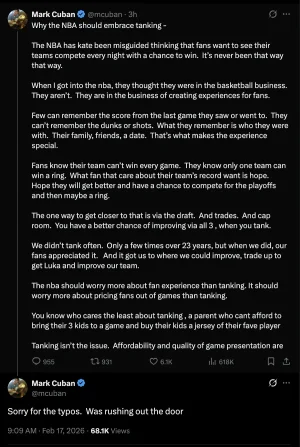
This anti-tanking talk goes against the ability to do that. You can convince yourself all you want that we had some kind of ethical tank, but at the end of the day a tank job is a tank job. Pretending one is more ethical than the other is just a coping mechanism.
Oh, you can definitely fix the ASG and we just saw how. I agree the most important part is the players giving a shit, but the shorter games clearly helped mantain the intensity. Short games = less chances of a blowout = players actually caring during crunch time.I actually kind of agree with this. The media - both legacy and otherwise - loves to have content and that means in the middle of a season bitching about things acting like they are huge problems when they are not. Do I GAF that the Jazz are tanking again? No not really. I don't watch Jazz games, and while it sucks for their fans, thats kind of when they can vote with their wallet. I don't know I just don't give a shit honestly.
I do like getting rid of the conferences, because I LOVE a balanced schedule and I think you could actually have a regular season trophy at that point like European Soccer leagues. I agree the owners are going to be extremely resistant to lowering the amount of games, which is why we have the NBA cup, but I think you could simply expand the NBA cup as a competition at that point to make up the difference. All of this takes us closer to the European soccer model which is much better for competition, IMO. Of course, the real lynchpin in that is relegation and promotion which isn't going to happen but the revenue model Scott brings is a watered down version of that. Staying in the upper divisions in soccer is important becuase of the revenue implications. You should make less money if you are at the bottom of the table and I don't mind that one bit. But it does hurt smaller markets.
As for the ASG, you can't fix it. You can't fix the dunk contest, you an't fix the game, because the only way to do that is to make the players give a shit about it and unless they are really competitive then they just don't seem to GAF. Edwards and Wemby did that shit last night and it was awesome, but then you have players on the court like Segun who obviously don't fucking care and it ruins it all. But honestly its the ASG, who gives a shit. Has it ever been anything has ever really cared about who won? No.
Oh, you can definitely fix the ASG and we just saw how. I agree the most important part is the players giving a shit, but the shorter games clearly helped mantain the intensity. Short games = less chances of a blowout = players actually caring during crunch time.
But the NBA didn't fix it, Wemby fixed it. Is he going to care that much every year? Maybe, but honestly I doubt it. Sure, if the players organically give a shit then it'll be better, but I don't know that I think that'll happen. But there's nothing really the NBA can do to facilitate that.

tearsofmorningdew
Well-known member
- Joined
- Sep 19, 2025
- Messages
- 1,970
- Reaction score
- 876
Totally agree. It’s the only hope franchises have to truly contend if they aren’t NYK (glad they haven’t won shit in 50 years), LAL, Miami. The DDR years were by far my least favorite time as a spurs fan. Hated everything about that team that was never going anywhere. Had much more fun the Wemby tank year, was proud to be at the game in Houston where sochan went to one handed fts lolMark Cuban's take on tanking. FWIW, I agree with him. We all hated the treadmill years of DDR and LMA. We all wanted us to finally tear it down and rebuild.
This anti-tanking talk goes against the ability to do that. You can convince yourself all you want that we had some kind of ethical tank, but at the end of the day a tank job is a tank job. Pretending one is more ethical than the other is just a coping mechanism.
View attachment 923


Exstatic
Well-known member
- Joined
- Sep 2, 2025
- Messages
- 2,049
- Reaction score
- 1,604
He’s a referee for all intents and purposes. The owners could never agree on a spokesman or MC from amongst themselves.Then why have a commissioner? No, he has a lot of power, as do all pro sports commissioners. He's just a weak pissant.
I think nobody is against the idea of trading players to bottom out and get a good pick. Because that way you are still playing and coaching to win games, you're just lacking in talent. What we all hate is when players and/or (mainly) coaches play and coach to lose. For example: the Jazz coach benching his starters in the 4th, or inventing injuries to keep players out. That's the type of tanking we all want to combat.Mark Cuban's take on tanking. FWIW, I agree with him. We all hated the treadmill years of DDR and LMA. We all wanted us to finally tear it down and rebuild.
This anti-tanking talk goes against the ability to do that. You can convince yourself all you want that we had some kind of ethical tank, but at the end of the day a tank job is a tank job. Pretending one is more ethical than the other is just a coping mechanism.
View attachment 923
They both did, that's the point. Wemby's intensity would have meant shit in a regular long ass game where the game is 100 to 73 in the 3rd quarter.But the NBA didn't fix it, Wemby fixed it. Is he going to care that much every year? Maybe, but honestly I doubt it. Sure, if the players organically give a shit then it'll be better, but I don't know that I think that'll happen. But there's nothing really the NBA can do to facilitate that.
- Joined
- Aug 29, 2025
- Messages
- 7,337
- Reaction score
- 9,373
But if you zoom out... what's really the difference?I think nobody is against the idea of trading players to bottom out and get a good pick. Because that way you are still playing and coaching to win games, you're just lacking in talent. What we all hate is when players and/or (mainly) coaches play and coach to lose. For example: the Jazz coach benching his starters in the 4th, or inventing injuries to keep players out. That's the type of tanking we all want to combat.
But to your point, I think Adam Silver has already rolled out the solution... just fine the teams who are engaging in the behavior you are trying to eliminate.
I'm completely fine with what you are saying and eliminating that kind of tanking... but I honestly don't think it's much different than gutting your roster to achieve the same goal. I suppose the main difference is that the team that guts their roster will have a longer climb back than the team who does a short term tank. Is that better? Worse?
I think the league would be well suited to think of the Fan Experience first and foremost (which is what Cuban is alluding to). Which of the scenarios below makes for a better fan experience:
Scenario A: a team guts their roster to "ethically" tank, and has a 3-5 year climb back to relevance.
Scenario B: a team has a play-in worthy team, like Utah now, but they "dirty" tank by sitting players with made up injuries, or sit them in the 4th quarter, so they can set themselves up to compete as soon as next year.
Scenario C: the same team as in Scenario B is "forced" into competing, and are a play-in team year after year. They don't have a pick high enough to be a true game changer, and aren't good enough or aren't in a market to attract free agents. They're just stuck in the middle.
I'd argue as a fan I'd rather see my team do Scenario A or B. Scenario C f'n sucks and just leads fans like us to talk about how we should just tear it apart already.
What's really the practical difference between A and B? If they both end up in a team losing 60 games... what does it matter?
Last edited:
The difference is that you aren't watching a WWE match in scenario A. You lose because you aren't good enough, and in the night where you ARE good enough to win, you win. You don't pull any bullshit to force the loss. I don't know about you, but that's a huge difference for me.But if you zoom out... what's really the difference?
But to your point, I think Adam Silver has already rolled out the solution... just fine the teams who are engaging in the behavior you are trying to eliminate.
I'm completely fine with what you are saying and eliminating that kind of tanking... but I honestly don't think it's much different than gutting your roster to achieve the same goal. I suppose the main difference is that the team that guts their roster will have a longer climb back than the team who does a short term tank. Is that better? Worse?
I think the league would be well suited to think of the Fan Experience first and foremost (which is what Cuban is alluding to). Which of the scenarios below makes for a better fan experience:
Scenario A: a team guts their roster to "ethically" tank, and has a 3-5 year climb back to relevance.
Scenario B: a team has a play-in worthy team, like Utah now, but they "dirty" tank by sitting players with made up injuries, or sit them in the 4th quarter, so they can set themselves up to compete as soon as next year.
Scenario C: the same team as in Scenario B is "forced" into competing, and are a play-in team year after year. They don't have a pick high enough to be a true game changer, and aren't good enough or aren't in a market to attract free agents. They're just stuck in the middle.
I'd argue as a fan I'd rather see my team do Scenario A or B. Scenario C f'n sucks and just leads fans like us to talk about how we should just tear it apart already.
What's really the practical difference between A and B? If they both end up in a team losing 60 games... what does it matter?
- Joined
- Aug 29, 2025
- Messages
- 7,337
- Reaction score
- 9,373
I can see your point... I just disagree. In Scenario A, you are still watching a WWE match (to use your analogy). It's just the Heavyweight Champ against a jobber with no chance to win from the get go.The difference is that you aren't watching a WWE match in scenario A. You lose because you aren't good enough, and in the night where you ARE good enough to win, you win. You don't pull any bullshit to force the loss. I don't know about you, but that's a huge difference for me.
If the Jazz win 26 games this year (their current pace) doing it this way... is that really worse than a team winning 14 games "the right way"? I guess... maybe?
But, I'll go along and say that we generally don't like what the Jazz are doing. But, we already have the solution. Just keep fining them.
But, I don't like the idea of forcing teams into that mediocre middle (but I also acknowledge if you do this, the flattened lottery odds that you originally suggested start to make more sense).
Ultimately, I personally don't think the system needs much fixing though. I kind of like the way it works now, and I think the Spurs experience over the last decade is a good demonstration of it working (along with the incentives playing out in real time). The post-Kawhi DDR/LMA era was horrible (and not because of DDR and LMA as players). Teams like the Bulls have been going through it for awhile and are finally seeing the light that they need to pull the plug. Good for them.
With the flattened odds, teams like the Bulls won't have the need to bottom out. They can still field the best team possible according to them and if it's not enough to make the playoffs, they can still get the #1 pick. Is that really such a bad thing?I can see your point... I just disagree. In Scenario A, you are still watching a WWE match (to use your analogy). It's just the Heavyweight Champ against a jobber with no chance to win from the get go.
If the Jazz win 26 games this year (their current pace) doing it this way... is that really worse than a team winning 14 games "the right way"? I guess... maybe?
But, I'll go along and say that we generally don't like what the Jazz are doing. But, we already have the solution. Just keep fining them.
But, I don't like the idea of forcing teams into that mediocre middle (but I also acknowledge if you do this, the flattened lottery odds that you originally suggested start to make more sense).
Ultimately, I personally don't think the system needs much fixing though. I kind of like the way it works now, and I think the Spurs experience over the last decade is a good demonstration of it working (along with the incentives playing out in real time). The post-Kawhi DDR/LMA era was horrible (and not because of DDR and LMA as players). Teams like the Bulls have been going through it for awhile and are finally seeing the light that they need to pull the plug. Good for them.
- Joined
- Aug 29, 2025
- Messages
- 7,337
- Reaction score
- 9,373
I understand the concept... but here's why I don't like it (in addition to the incentive you've created for teams at the end of the playoffs to drop down into the lottery, that I've already discussed):With the flattened odds, teams like the Bulls won't have the need to bottom out. They can still field the best team possible according to them and if it's not enough to make the playoffs, they can still get the #1 pick. Is that really such a bad thing?
There are still only so much room at the top of the draft. So now we've created this whole, mediocre middle class, but there are still only going to be a few winners and losers and more teams are just going to be stuck on the treadmill for longer, waiting their turn to get lucky with the flat odds. I'll pass on sticking with more DDR/LMA era mediocrity and hoping we get lucky in the lotto. I prefer the ability to just bottom out.
As if that didn't happen now already. I really doubt much changes with flattened odds aside from teams not having the need to have the worst record possible. Good managers will still find a way to make their teams good and bad managers will continue to fuck up and keep their teams in perpetual suckage, imho.I understand the concept... but here's why I don't like it (in addition to the incentive you've created for teams at the end of the playoffs to drop down into the lottery, that I've already discussed):
There are still only so much room at the top of the draft. So now we've created this whole, mediocre middle class, but there are still only going to be a few winners and losers and more teams are just going to be stuck on the treadmill for longer, waiting their turn to get lucky with the flat odds. I'll pass on sticking with more DDR/LMA era mediocrity and hoping we get lucky in the lotto. I prefer the ability to just bottom out.
- Joined
- Aug 29, 2025
- Messages
- 7,337
- Reaction score
- 9,373
It does happen now, but it can be modulated by bottoming out. Your proposal is taking that away, which is why I don't like it.As if that didn't happen now already. I really doubt much changes with flattened odds aside from teams not having the need to have the worst record possible. Good managers will still find a way to make their teams good and bad managers will continue to fuck up and keep their teams in perpetual suckage, imho.
We simply aren't going to agree on this, and that's okay. But those are my reasons why, and you haven't done anything to dispel any of my reasons... thus, I don't like your proposal.
Exstatic
Well-known member
- Joined
- Sep 2, 2025
- Messages
- 2,049
- Reaction score
- 1,604
B is a dumb way to tank, but it has its own built in “ punishment “. By having expensive players already on the roster before you get “ the guy”, you forgo selling your cap room and accruing assets to use to put around “ your guy”. It’ll be Milwaukee all over again, a brief run, maybe a title, maybe not, before everyone brought in around their chosen one ages out, and they have to sell off the golden child to avoid losing him for nothing. Lather, rinse, and repeat, and I’m here for it, Mr. Ainge. It’s just another form of treadmill.
- Joined
- Aug 29, 2025
- Messages
- 7,337
- Reaction score
- 9,373
Maybe it is, maybe it isn't... but let teams pursue whatever path they want, and be forced to live with the outcomes, is my opinion.B is a dumb way to tank, but it has its own built in “ punishment “. By having expensive players already on the roster before you get “ the guy”, you forgo selling your cap room and accruing assets to use to put around “ your guy”. It’ll be Milwaukee all over again, a brief run, maybe a title, maybe not, before everyone brought in around their chosen one ages out, and they have to sell off the golden child to avoid losing him for nothing. Lather, rinse, and repeat, and I’m here for it, Mr. Ainge. It’s just another form of treadmill.

ambchang
🧑🔧🔛🕕
- Joined
- Sep 5, 2025
- Messages
- 803
- Reaction score
- 747
I’d say the major differences are:But if you zoom out... what's really the difference?
But to your point, I think Adam Silver has already rolled out the solution... just fine the teams who are engaging in the behavior you are trying to eliminate.
I'm completely fine with what you are saying and eliminating that kind of tanking... but I honestly don't think it's much different than gutting your roster to achieve the same goal. I suppose the main difference is that the team that guts their roster will have a longer climb back than the team who does a short term tank. Is that better? Worse?
I think the league would be well suited to think of the Fan Experience first and foremost (which is what Cuban is alluding to). Which of the scenarios below makes for a better fan experience:
Scenario A: a team guts their roster to "ethically" tank, and has a 3-5 year climb back to relevance.Scenario B: a team has a play-in worthy team, like Utah now, but they "dirty" tank by sitting players with made up injuries, or sit them in the 4th quarter, so they can set themselves up to compete as soon as next year.Scenario C: the same team as in Scenario B is "forced" into competing, and are a play-in team year after year. They don't have a pick high enough to be a true game changer, and aren't good enough or aren't in a market to attract free agents. They're just stuck in the middle.
I'd argue as a fan I'd rather see my team do Scenario A or B. Scenario C f'n sucks and just leads fans like us to talk about how we should just tear it apart already.
What's really the practical difference between A and B? If they both end up in a team losing 60 games... what does it matter?
1) a is easier to gamble on
2) for a people would know who they get to watch when they dish out $100 a ticket plus parking and food
3) tickets for a would be cheaper because there are no chances of catching the good roster.

k....
Active member
- Joined
- Sep 20, 2025
- Messages
- 170
- Reaction score
- 61
Maybe they should scrap determining lottery positions by position, and instead, embrace gambling and reward teams beating the spread. Or do an inverse lottery against bottom half teams. So winning winnable games is good, otherwise tank at will.

inagra
Duncan gave us 5
- Joined
- Sep 19, 2025
- Messages
- 247
- Reaction score
- 166
I’ve read 7–8 proposed fixes for NBA tanking, and nearly all of them are vulnerable to manipulation. The only system that truly eliminates incentives to tank is The Wheel.
The real question is whether teams and fanbases would tolerate potentially waiting 30 years for a top pick.
The real question is whether teams and fanbases would tolerate potentially waiting 30 years for a top pick.

spurs2112
Active member
- Joined
- Nov 12, 2025
- Messages
- 167
- Reaction score
- 96
I personally don't like when teams tank. It just makes for a shitty product and a hard watch. Imagine going to a game knowing your team is playing to lose. I know not every team is going to be good but there shouldn't be professional ball clubs finishing the season with wins in the teens or low 20's either. Thats why I think to even be eligible for a high pick you have to win a certain amount of games. There could be some wiggle room if a player/s get injured for a long period of time but overall if the squad is healthy they should play and try to win. So I don't agree on Cuban on that part. Fans may not remember the score but they sure will remember that beat down the team got or how shitty the season was. I do agree with Cuban about pricing out the fans though. The cost to see a game is ridiculous in my opinion. If teams are tanking those games should be free lol. At the end of the day I only watch the Spurs and could really care less about the other teams.
There option play young guys how they develop or play old guys that give fans no inspiration the product still sucks it is what it is bad teams are bad teamsI personally don't like when teams tank. It just makes for a shitty product and a hard watch. Imagine going to a game knowing your team is playing to lose. I know not every team is going to be good but there shouldn't be professional ball clubs finishing the season with wins in the teens or low 20's either. Thats why I think to even be eligible for a high pick you have to win a certain amount of games. There could be some wiggle room if a player/s get injured for a long period of time but overall if the squad is healthy they should play and try to win. So I don't agree on Cuban on that part. Fans may not remember the score but they sure will remember that beat down the team got or how shitty the season was. I do agree with Cuban about pricing out the fans though. The cost to see a game is ridiculous in my opinion. If teams are tanking those games should be free lol. At the end of the day I only watch the Spurs and could really care less about the other teams.
spurs2112
Active member
- Joined
- Nov 12, 2025
- Messages
- 167
- Reaction score
- 96
I guess the question is are bad teams really that bad or playing to be bad. I know there will always be bad or less talented teams. But with the carrot of a top pick dangled in front of them we know currently teams play to be bad in most cases.There option play young guys how they develop or play old guys that give fans no inspiration the product still sucks it is what it is bad teams are bad teams

Sugus
Race for Seis
- Joined
- Sep 9, 2025
- Messages
- 652
- Reaction score
- 722
Does "the way it works now" include what the Jazz are doing? If so - then it absolutely can't stay that way. There have always (and will always) be questions about the "integrity of the game", but having teams actively throw games in plain daylight is a blemish on the league - and a terrible product for them to put out, as far as their intere$$$ts go.Ultimately, I personally don't think the system needs much fixing though. I kind of like the way it works now, and I think the Spurs experience over the last decade is a good demonstration of it working (along with the incentives playing out in real time). The post-Kawhi DDR/LMA era was horrible (and not because of DDR and LMA as players). Teams like the Bulls have been going through it for awhile and are finally seeing the light that they need to pull the plug. Good for them.
The gambling genie is out of the bottle, they're probably not reversing that shit anytime soon. So the next best thing is to address the only thing (sans the Clippers saga) which threatens the league's reputation/integrity, and that's tanking. Whether they put a Wheel, or do some scoring system, or make rookies FAs or whatever, the system as it stands is being shamelessly exploited and the owners aren't going with it.
You're 100% right in that the Spurs showed how it should work, which is why I think beyond any actual changes, Silver would be stupid not to send some internal memo on "hey, we understand middling teams have a strategic investment in drafting high, but there's an Acceptable way to go about it, and These Examples [123] Ain't It". Keep it in house, make some public gesture, move on.
Similar threads


- Replies
- 42
- Views
- 523
